
Google Advertising – How Does It Work? A Guide for SMEs
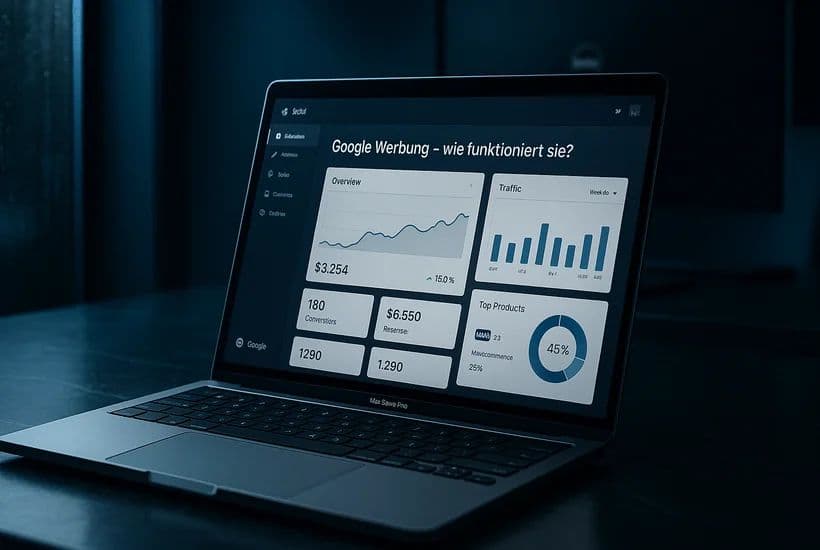
Google Advertising – How Does It Work? The Practical Guide for Swiss SMEs
Anyone searching in Switzerland today for a product, a service or a local provider starts, in the vast majority of cases, on Google. This is exactly where paid Google advertising comes in – but how does it work in concrete terms, what does it cost, and is it worth getting started for an SME in Zurich, Bern or Basel? In this guide you will find well-founded answers, current figures from the Swiss market and concrete recommendations so that you use your advertising budget sensibly from the very start.
The Basic Principle: How Google Advertising Works in Detail
Google advertising – known in the trade as Google Ads – is based on an auction system that runs in fractions of a second. Every time someone enters a search query, Google decides on the basis of several factors which ads appear in which order. The three decisive variables are:
- Bid: The maximum amount you are willing to pay per click.
- Quality Score: A rating from 1–10 that summarises ad relevance, expected click-through rate and user experience on the landing page.
- Ad Rank: The product of bid and Quality Score, supplemented by the expected impact of ad extensions.
The key point: you do not automatically pay your maximum amount. In fact, you only pay as much as is needed to outbid the advertiser in the next position down. A high Quality Score can therefore reduce the actual click price considerably – a point many SMEs underestimate.
The Most Important Campaign Types in 2026
Google Ads is long since more than a simple text ad above the search results. The platform now comprises an entire ecosystem of ad formats:
- Search Ads: Text-based ads that appear directly for relevant search queries. For SMEs with a clear service or local offering, still the strongest channel.
- Performance Max: AI-driven campaigns that are served automatically across all Google channels – Search, Display, YouTube, Gmail, Maps and Discover. In 2026, Performance Max is the campaign type Google pushes hardest.
- YouTube Ads & Shorts Ads: Video ads that run before, during or after YouTube videos. Short-form ads in YouTube Shorts are currently seeing the strongest growth.
- Display Ads: Banner ads on over two million websites in the Google Display Network. Primarily suited to brand awareness and remarketing.
- Shopping Ads: Product ads with image and price – indispensable for online shops. If you are having an online shop built, Shopping campaigns should be planned in from the start.
- Local Services Ads: Particularly relevant for local service providers in Swiss cities who want to be found directly via Google Maps.
Google Advertising – How Does It Work for Swiss SMEs in Practice?
Theory is one thing; implementation for an SME with a limited budget is another. Here is a realistic sequence of how a mid-sized company in Switzerland typically starts with Google Ads:
Step 1: Keyword Research and Market Analysis
Before a single franc flows into ads, it must be clear which terms your target group searches for. For a Zurich painting business, these could be terms such as “painter Zurich”, “apartment painting price” or “facade renovation Zurich”. Tools such as the Google Keyword Planner provide search volumes and estimated click prices. A professional free SEO analysis additionally reveals which keywords already rank well organically and where paid ads offer the greatest leverage.
Step 2: Campaign Structure and Ad Creation
A clean account structure is the backbone of successful Google advertising. Splitting by service area or product category has proven effective, with each ad group containing tightly themed keywords. The ad copy itself must contain the keyword, communicate a clear benefit and offer a call to action.
Important for Switzerland: campaigns should be set up separately by language. A German-Swiss campaign works differently from a campaign for French-speaking Switzerland – not only linguistically, but also culturally.
Step 3: Bidding Strategies and Budget
In 2026, Google relies almost entirely on automated bidding strategies. The most common options are:
- Maximise conversions: Google automatically optimises bids to achieve as many conversions as possible within the budget.
- Target ROAS (return on ad spend): You specify the desired revenue per franc invested, e.g. 5:1.
- Target CPA (cost per acquisition): You define the maximum a lead or a purchase may cost.
To get started, we recommend Swiss SMEs a monthly budget of CHF 800–2’000. In competitive industries such as finance or law, where a single click can cost CHF 5.00–9.00, the budget should be set correspondingly higher.
Step 4: Tracking and Optimisation
Without clean conversion tracking, Google advertising is flying blind. Enhanced Conversions and server-side tracking are the standard in 2026 – especially after the far-reaching cookie restrictions of recent years. This is the only way to measure whether an ad has actually led to a phone call, a quote request or a purchase.
After the first two to four weeks, enough data is available for targeted optimisation: pause weak keywords, test ad copy, adjust bids and add negative keywords that prevent irrelevant clicks.
Current Figures: What Does Google Advertising Cost in Switzerland?
Costs vary greatly by industry and region. Here is an overview of average click prices (CPC) for the Swiss market in 2026:
- Tourism & hospitality: CHF 0.60–1.40
- Trades & construction: CHF 1.00–2.50
- E-commerce (general): CHF 0.80–2.00
- Finance & insurance: CHF 4.50–8.00
- Law & consulting: CHF 5.00–9.00
The average click-through rate (CTR) for Swiss Search Ads is 5.5–7.8%, the conversion rate 3.5–5.2%. Well-optimised campaigns achieve a ROAS of 4:1 to 6:1 – meaning that every franc invested generates four to six francs in revenue.
Agency, Freelancer or Do It Yourself? An Honest Comparison
Sooner or later, every SME faces this question. Here are the pros and cons of the three options:
Managing Google Ads Yourself
- Advantages: No external costs, full control, direct learning.
- Disadvantages: High time investment, steep learning curve, typical beginner mistakes quickly cost several hundred francs. Google's own recommendations in the account often serve Google's revenue – not yours.
Hiring a Freelancer
- Advantages: Cheaper than an agency (often CHF 100–150/h), a personal point of contact.
- Disadvantages: Dependence on a single person, limited capacity, no backup in case of illness or holidays, rarely access to advanced analysis tools.
Hiring a Specialised Agency
- Advantages: Broad know-how across various industries, established processes, access to premium tools, ongoing optimisation, cover arrangements.
- Disadvantages: Higher monthly costs (typically a CHF 500–2’000 management fee on top of the media budget), communication channels somewhat longer.
For Swiss SMEs aiming for sustainable results, working with an experienced Google Ads agency is advisable. The reason: the platform is becoming ever more complex, AI-driven campaign types such as Performance Max require in-depth expertise, and optimisation mistakes can quickly become expensive at Swiss click prices.
SGE, AI and First-Party Data: What Has Changed in 2026
The search landscape has changed noticeably over the past two years. Three developments are particularly relevant for your Google advertising:
Search Generative Experience (SGE)
For many search queries, Google shows AI-generated summaries directly in the results. Paid ads appear prominently above and partly within these AI overviews. This changes click behaviour: users who click on an ad already have a higher purchase intent, as informational questions are often answered by the AI summary. Click quality rises – but so does competition for the remaining clicks.
AI-Assisted Campaign Optimisation
In 2026, Google automatically generates ad copy and image variants, tests them against each other and optimises in real time. That sounds convenient – but carries risks. Without human oversight, the AI can shift budget to irrelevant placements. Regular manual review remains indispensable.
First-Party Data and Tracking
After the end of third-party cookies, your own data strategy is critical to success. Enhanced Conversions, which transmit hashed customer data (email, phone number) to Google, and server-side tracking via the Google Tag Manager server container are the gold standard in 2026. Without these measures, you lose up to 30% of your conversion data – and with it the basis for intelligent bidding strategies.
Google Advertising and SEO: Why You Need Both
A common misunderstanding: Google Ads and search engine optimisation (SEO) are not competitors but allies. Google Ads delivers immediate visibility, SEO builds organic reach in the long term. Combining both channels demonstrably leads to better results than either channel alone.
In concrete terms: data from Google Ads – such as which keywords have the highest conversion rate – feeds directly into your SEO strategy. Conversely, a well-optimised website raises the Quality Score of your ads and thus lowers your click costs. If you want to interlink both strategically, you benefit from working with an SEO agency in Zurich that also handles ads management.
Conclusion: Google Advertising – How Does It Work Successfully for Your SME?
Google advertising works through an auction system that rewards relevance. Anyone who chooses the right keywords, builds clean campaign structures, consistently implements conversion tracking and optimises on an ongoing basis achieves measurable results with a manageable budget. The question is not whether Google advertising works for Swiss SMEs – but whether it is implemented professionally enough to realise its full potential.
The Swiss market, with its comparatively high click prices, does not forgive beginner mistakes. Every franc spent wrongly is one too many. At the same time, well-optimised campaigns with a ROAS of 4:1 to 6:1 offer one of the strongest growth levers in digital marketing.
Would you like to know how much potential Google Ads offers for your business? We analyse your current situation, your industry and your competitors – free of charge and without obligation. As a Google Ads agency based in Zurich, we support Swiss SMEs from strategy development through to ongoing optimisation. Secure your free initial analysis now, before your competition occupies the best ad positions. Get in touch now – we will get back to you within 24 hours.
Frequently Asked Questions (FAQ)
How much does Google advertising cost an SME in Switzerland per month?
How quickly will I see results from Google advertising?
Is Google advertising also worthwhile for local SMEs in Zurich, Bern or Basel?
Which is better – running Google Ads myself or hiring an agency?
Request a Free Initial Consultation
Would you like to improve your online visibility and win more customers in Switzerland? eSys Agency advises you without obligation – with concrete measures that really work.
Due to high demand, only a few consultation slots are currently available.
Digital agency for Swiss SMEs · About us